





In the past few decades, the digital marketplace has shifted from a “Field of Dreams” mentality, where businesses believed simply having a website was enough, to a hyper-competitive environment where the customer is the center of the universe. Metamorphosis has been accelerated by the rapid adoption of Artificial Intelligence (AI) in search engines. Today, consumers do not visit stores; they utilize digital devices to research merchants, compare prices, and read reviews before making a single decision.
Search engines have evolved from simple directories of blue links into sophisticated answer engines like Google Gemini, ChatGPT, and Perplexity. In this new landscape, AI agents act as strict gatekeepers. They scan the web not for keywords, but for trust. Scanning the entire web, they distinguish between legitimate authorities and digital noise. Consequently, your brand, consisting of reputation, technical ownership, and expertise, is no longer a marketing luxury, but essential to your business’s survival.
If your online presence relies on rented land or generic templates, you become invisible to the AI models that now guide consumer decisions. To win, small to mid-size businesses (SMBs) must establish a brand signaling Experience, Expertise, Authoritativeness, and Trustworthiness (E-E-A-T) to both humans and machines.
Key Takeaways
- The Intent Revolution and The Zero-Click Challenge: AI searches now focus on concept matching and user intent rather than simple keyword matching. Your brand must answer the why behind a user’s question. With nearly 58.5% of searches ending without a click, the goal is to be authoritative enough to be cited directly in AI-generated summaries.
- E-E-A-T is Non-Negotiable: To be recommended by AI, your brand must prove its Experience, Expertise, Authoritativeness, and Trustworthiness, with Trust being the ultimate signal.
- The Digital Mouse Strategy: Small businesses can defeat corporate “elephants” by utilizing agility, finding niches the giants ignore, and adapting quickly to technological shifts.
- Ownership is Security: You must legally own your CMS and domain. Renting a template leaves your brand vulnerable to total deletion if you stop paying monthly fees.
- Reviews are Data: Online reviews are training data that teach AI about your reliability. This is critical for high-ticket items, as customers research purchases over $500 much more rigorously than $10 items.
- The T.R.I. Compass: Choose partners based on Trust, Relationships, and Integrity (T.R.I.) to ensure a sustainable future.
1. The AI Filter: From SEO to AEO

The internet is currently being flooded with low-quality, AI-generated noise. To manage this, search engines are acting as stricter filters, prioritizing brands that demonstrate genuine human experience.
A. The Rise of Answer Engine Optimization (AEO): In the past, a user might search for “best auto repair,” and a search engine would provide a list of local shops. Today, AI engines use Natural Language Processing (NLP) to grasp the intent behind complex queries. They synthesize a direct answer, often removing the need for the user to visit a website at all. This process is called Answer Engine Optimization (AEO): preparing your website to provide clear, factual content that AI can cite as a verified source.
In 2024, approximately 58.5% of Google searches ended without a click. This “zero-click” reality means that if your brand lacks the authority to be cited in the “AI Overview,” you effectively do not exist for that customer. However, the traffic that does click through is highly valuable, as it has been pre-qualified by the AI.
B. Generative Engine Optimization (GEO): This landscape demands a shift from traditional Search Engine Optimization (SEO) to Generative Engine Optimization (GEO). While traditional SEO chases keywords and backlinks, GEO focuses on context and comprehension. AI models view your brand as an entity. If your site is a generic template with copied content, the AI cannot distinguish you from thousands of competitors. To be cited, you must become the definitive source in your niche, providing structured answers that AI tools can easily parse.
2. E-E-A-T: The New Digital Currency

If content is the vehicle for your message, trust is the fuel that powers it. Google and other AI systems utilize the E-E-A-T framework to judge credibility.
- Experience: AI places a premium on human-first content. You must show that you’ve done the work. This involves sharing real photos, original case studies, and narratives that only a human could construct.
- Expertise: You must prove your skillset. Author bios should clearly list degrees, credentials, and years of practice. AI looks for evidence that content creators are subject matter experts.
- Authoritativeness: This relies on external validation. Are reputable industry websites linking to you? Is your brand mentioned in local news? These backlinks serve as votes of confidence.
- Trustworthiness: Here is the most critical pillar. It includes technical security (HTTPS), accurate data, and transparent contact information. If this software cannot verify your identity or location, it will not risk recommending you.
The Content Moat Strategy: To secure your authority, you should build a Content Moat, indispensable content that is difficult for competitors to replicate. Instead of creating generic posts, focus on cornerstone content like comprehensive guides or original research. You can then implement a Hybrid Human-AI Workflow: use AI for research and outlining, but ensure humans inject brand personality and fact-check every detail. This approach increases output while maintaining human authenticity these systems crave.
3. The Digital Mouse Strategy
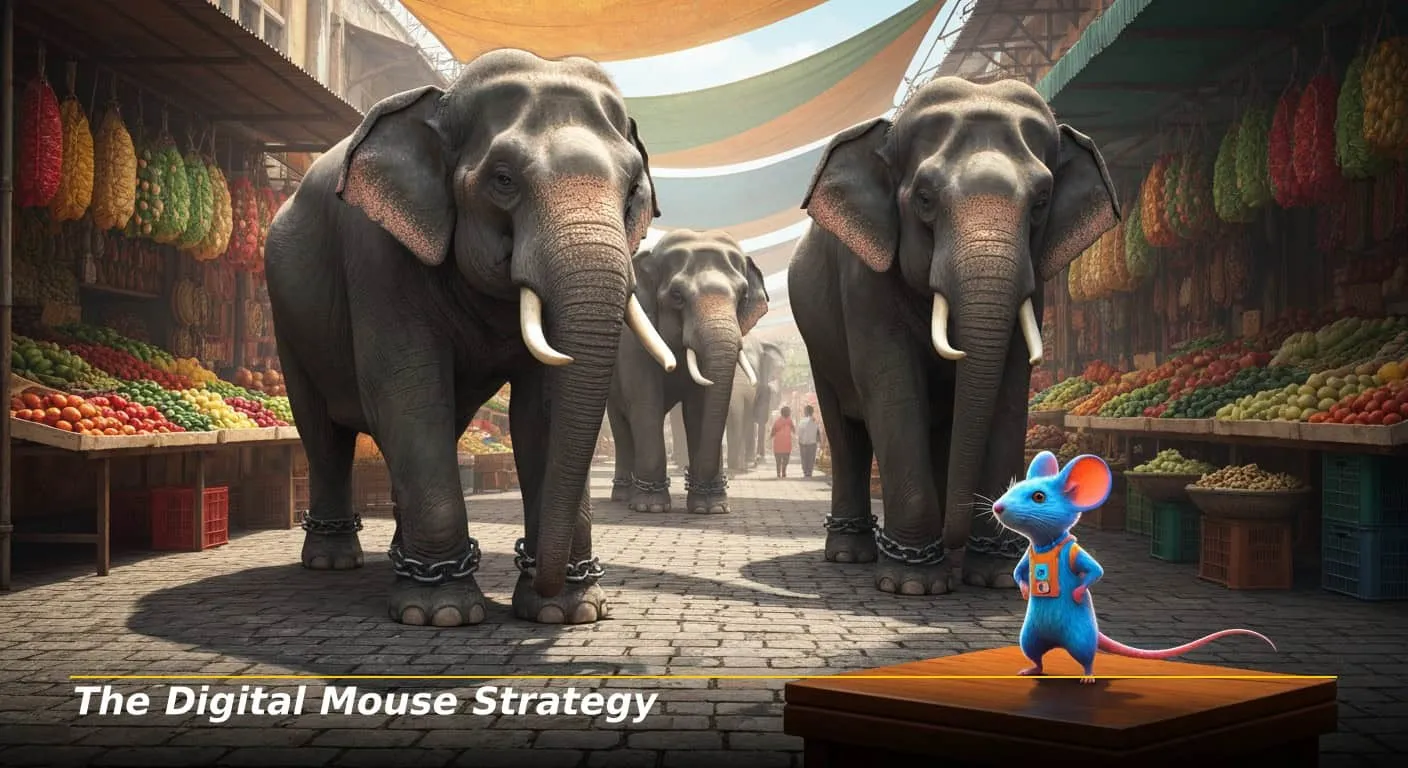
Small business owners often feel overwhelmed by massive national competitors, viewing them as unstoppable giants. In the AI era, however, it is helpful to view these corporations as slow-moving elephants and your business as an agile digital mouse.
A. Agility beats Bureaucracy: Elephants are slow. They are weighed down by legacy systems, legal reviews, and corporate bureaucracy. It may take them months to approve a strategy change. As a digital mouse, speed is your secret weapon. You can implement new AI tools, optimize your site for mobile, and pivot your messaging over a single weekend.
B. Niche Dominance: Large corporations often ignore specific niches because the financial returns are too small to justify their massive overhead. This is your competitive advantage. By focusing on a narrow space, and becoming the absolute authority there, you can win where the elephants cannot compete. For instance, rather than competing broadly on electronics, a small brand like NewEgg.com initially competed against Best Buy by leveraging e-commerce agility to offer lower prices and specific components this competitor ignored.
4. Technical Branding: Your Digital Infrastructure

Your brand is more than a logo; it is your technical infrastructure. In the age of AI, technical performance is interpreted as a direct signal of brand quality.
A. The Mobile-First Requirement: Global mobile commerce is projected to reach $2.2 trillion in 2024, driving 60% of all e-commerce sales. Search engines utilize mobile-first indexing, meaning they judge your brand primarily by its mobile version. If a site is not responsive (auto-resizing for tablets and phones), you are alienating the majority of your audience. Statistics indicate that 96% of users will abandon a website if the mobile experience is poor. A non-responsive site signals to AI that your brand is irrelevant and outdated.
B. Speed as a Trust Signal: Both AI models and human users demand speed. If a site takes longer than 10 seconds to load, visitors will leave. To satisfy AI ranking signals like Core Web Vitals, you should aim for a Largest Contentful Paint (LCP) of 2.5 seconds or less. Slow sites ruin trust, suggesting to the user that the business is technically incompetent or inefficient.
C. The Danger of the Rental Model: A significant risk to brand authority is using rental website providers, often costing $15 to $25 a month.
- The Trap: You typically do not own the content or the domain name; you are leasing a sub-domain (e.g., YourBussinessName.ProviderDomain.com). You are building your brand equity on someone else’s property.
- The Consequence: If you leave that provider, your brand vanishes. Disappearing are E-E-A-T signals, backlinks, and history.
- The Solution: You must insist on 100% ownership of your content and domain. Utilizing an open-source Content Management System (CMS) including WordPress ensures you can move your digital asset to any host you choose.
5. Reputation Management: Training the AI

In the past, reviews were social proof for humans. Today, they serve as training data for machines.
A. Reviews as Data Points: AI search engines scan platforms like Yelp, Google Reviews, and Facebook to understand sentiment. They analyze the emotional tone of feedback to determine reliability. Consistent stream of positive reviews tells the AI that your business is trustworthy and active.
- Transaction Value Impact: The importance of reviews correlates with price. If a customer purchases a $10 disposable camera, they may not check reviews. However, for a $500 purchase, they will almost certainly research peer opinions.
B. Shaping the Narrative: Social sharing and reviews spread six times wider than traditional word-of-mouth, creating a Word-of-Mouse effect. If you consistently receive negative feedback, it is not a difficult customer issue; it is a business problem. AI uses sentiment analysis to categorize your brand. If that sentiment is negative, agents will filter you out. You must proactively ask satisfied customers for reviews, perhaps by emailing them instructions, and respond professionally to shape the narrative the AI learns about your brand.
6. Partner Selection: The T.R.I. Standard

Building a brand capable of surviving the AI era is complex and requires a true partner. To vet potential agencies, look for the T.R.I. values: Trust, Relationships, and Integrity.
The Vetting Checklist: Use the following questions to ensure your partner can build a brand-centric presence:
- Eat Your Own Cooking: “Does your agency rank in the top 5 of Google AI Overview for your own industry key phrases?” If they cannot build authority for themselves, they cannot do it for you.
- Ownership: “Will I legally own my website content and domain name from day one?”
- Empowerment: “Do you specialize in CMS design, and will you coach me on how to make my own updates?” A quality partner empowers you to control your voice and save money on maintenance.
- Full-Service Capability: “Do you handle hosting, design, SEO, and maintenance?” Consolidating these services ensures accountability.
- Performance Guarantees: “What guarantees do you offer regarding ranking my website?” Reputable firms will guarantee a percentage (e.g., 80%) of keywords will rank in the top 10 within 4-6 months.
Conclusion: The Brand is the Business
In the AI era, your brand is the most powerful asset to possess. It serves as a beacon that guides AI search engines through the fog of generic content to find you. It is the promise of quality that converts a zero-click summary into a loyal customer.
Small businesses possess a distinct advantage. By adopting the Digital Mouse mindset, you can move quickly to implement E-E-A-T principles, optimize for AI search, and cultivate a sterling reputation through authentic reviews. Do not settle for a half-baked or rented web presence. Invest in a custom, owned, and authoritative digital footprint. By partnering with experts valuing Integrity and Results, you secure your place not only in the search results, but the center of your customer’s universe.
FAQs About Building Brand Authority to Survive the AI Revolution
1. How does building brand authority differ for B2B companies versus B2C companies?
While both require a professional presence, the strategy for building authority differs based on the sales cycle. B2B companies typically face longer sales cycles involving multiple decision-makers (such as CEOs and COOs) and higher transaction values. Therefore, B2B content must address specific personas of everyone involved in the decision process to build consensus. In contrast, B2C customers often possess lower switching costs and make faster decisions based on price, convenience, or emotional connection. For B2C, authority is often built through immediate social proof and seamless mobile experiences.
2. Can I redesign my existing website to meet AI standards, or must I start from scratch?
You do not always need to rebuild from the ground up. If the current site has valuable content but looks outdated or suffers from technical issues, a redesign can modernize the look and improve performance while preserving your existing domain authority. A professional team can audit your current digital footprint to determine if a refresh is sufficient to fix technical debt or if a full rebuild is necessary to achieve the speed and structure required for AI optimization.
3. How can a small team produce enough Expert content to satisfy E-E-A-T requirements?
You can maximize your resources by making every piece work overtime. Instead of constantly creating new topics, create one comprehensive cornerstone guide (which builds authority), and then repurpose it into smaller formats. A single 3,000-word guide can be broken down into 5–10 social media posts, a webinar, an email sequence, and an infographic. This makes it practical to create a Content Moat, indispensable content that is hard for competitors to replicate, without burning out your team.
4. What are the specific risks of using AI tools to generate my brand’s content?
While AI is efficient, relying on it blindly can damage your brand authority. Risks include intellectual property concerns (as AI sources data from across the web), security risks regarding sensitive business data, and the potential for generating generic content that lacks real-world nuance. To maintain the Trustworthiness component of E-E-A-T, it is recommended that a human expert review all AI-generated content to ensure it reflects your specific company culture and factual accuracy.
5. Which pricing model is best for maintaining a high-authority website: Fixed-Price or Hourly?
The right model depends on your business stage. Fixed-Price models are ideal for well-defined projects where you need budget certainty and clear deliverables, such as a website launch. An Hourly Rate offers flexibility for evolving projects where the scope might change. However, for long-term authority building, many businesses benefit from a Monthly Subscription or retainer that covers hosting, security updates, and design tweaks, ensuring the site evolves alongside changing AI trends without unpredictable costs.
6. Beyond digital marketing, are there low-cost ways to boost my brand authority locally?
Yes. You can extend your marketing reach by running a piggyback marketing campaign with non-competing businesses that offer complementary services. For example, an auto repair shop might cross-promote with a local auto body shop. Since both businesses recommend the other, you borrow each other’s credibility. This mutual validation acts as a powerful trust signal to local customers and can generate referrals that reinforce your standing in the community.
7. How involved do I need to be in the design process to ensure my brand voice is authentic?
While you don’t need to manage day-to-day technical details, your involvement is critical during the Discovery and Strategy phases. A web partner cannot guess your business goals or unique value proposition. You should expect to collaborate on goal setting, approve designs at key milestones, and provide feedback on the tone of the content. This collaboration ensures the final digital product is not a generic template, but an authentic reflection of your business identity.
