





In the legacy era of traditional marketing, businesses operated under a Ptolemaic perspective, the assumption that their company was the center of the commercial universe and customers would naturally orbit their storefront or website. Today, technology has forced a fundamental inversion. We now live in a Galilean marketplace: consumers are the sun, and your business must revolve around their needs, intentions, and digital habits to remain relevant.
This shift is driven by the rapid rise of Artificial Intelligence (AI). Search engines metamorphosed from simple keyword-matching directories into sophisticated answer engines synthesizing data to provide direct solutions. For small to mid-size businesses (SMBs), this isn’t a threat; it’s an unprecedented opportunity. By leveraging high-quality content marketing, an agile business can act as a digital mouse, out-maneuvering the slow-moving elephants of the corporate world. Content is no longer information, it is the fuel for your 24/7 sales engine.
Key Takeaways
- From Keywords to Intent: AI search prioritizes understanding the why behind a query, requiring content specific user problems and conversational natural language.
- The E-E-A-T Mandate: To be cited by AI models like ChatGPT or Google Gemini, your brand must demonstrate Experience, Expertise, Authoritativeness, and Trustworthiness.
- AEO & GEO: Success requires Answer Engine Optimization (AEO) to ensure your content is structured for extraction into AI-generated summaries and zero-click results.
- Agility over Budget: Small businesses win by moving faster than large competitors, capitalizing on niche markets, and adapting to technological shifts in real-time.
- Total Ownership: Avoid rented template platforms; prioritize custom CMS websites (like WordPress) where you own the domain and digital real estate.
- The T.R.I. Framework: Partner only with digital agencies valuing Trust, Relationships, and Integrity, and can prove expertise by ranking their own company website.
1. Decoding the AI Search Revolution

The internet is no longer a static library of links. It has become a dynamic ecosystem where AI agents, notably Google’s AI Overviews, Perplexity, and Bing Copilot, act as gatekeepers.
A. Beyond the 10 Blue Links
Traditional SEO focused on ranking in a list of results. Modern search focuses on being the synthesized answer. AI search engines use Natural Language Processing (NLP) to grasp the full context of a query from voice command, visual search, or complex conversational prompt. The goal for an SMB is to be the definitive resource AI cites when a user asks a question like, “How often should I change my timing belt?” rather than appearing for the keyword auto repair.
B. The Zero-Click Phenomenon
In 2024, nearly 59% of searches ended without clicking to a website. This is because AI provides the answer directly on the search results page. While this might seem discouraging, traffic that does click through is highly pre-qualified. Because AI has already satisfied casual inquiries, the visitors reaching your site are further along in the purchase journey and ready to engage. Being cited in an AI summary builds a level of authority that traditional advertising cannot buy.
2. Content Marketing: Your Competitive Superpower
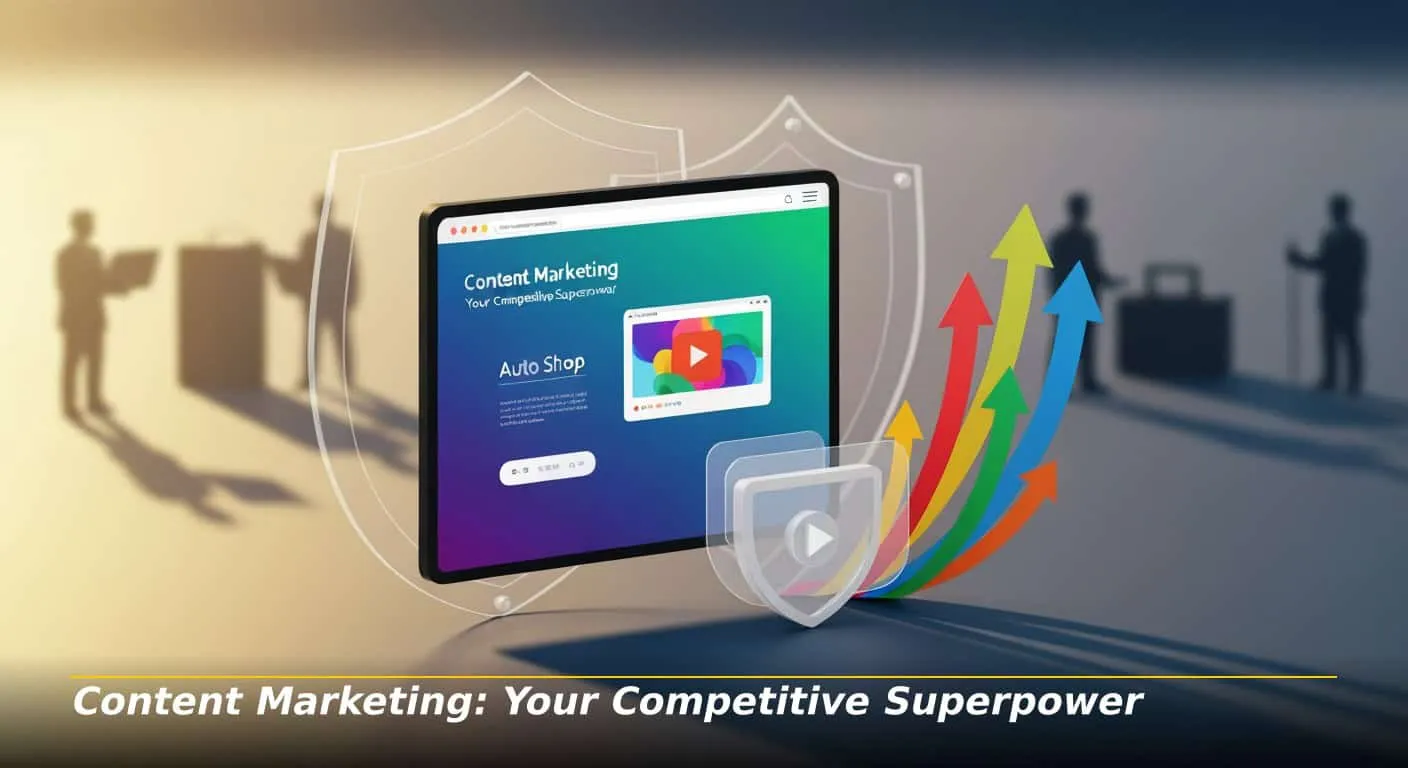
In an age where information is free and instant, content is your primary tool for establishing trust before a customer ever picks up the phone.
A. The Problem-Solving Approach
The days of competing with a list of products are gone. Modern consumers educate themselves extensively before selecting a provider. If you own an auto shop and the site provides detailed answers about mileage between oil changes or brake safety, you set yourself apart as a trusted advisor. This positions your website closer to the center of the online universe, gathering additional attention through viewership and social sharing (word-of-mouse).
B. Building a Content Moat
Content marketing is nearly 62% cheaper than traditional marketing yet generates three times as many leads. By creating cornerstone content, comprehensive guides that become industry references, you build a protective barrier around your brand. Industry figureheads often ignore niche products or services because they don’t yield necessary returns for their massive overhead. With small businesses, these niches are the fuel for sustainable growth.
| Marketing Aspect | Traditional Advertising | Content Marketing (AI Era) |
| Philosophy | Business-centric (Ptolemaic) | Customer-centric (Galilean) |
| Trust Factor | Low (Paid promotion) | High (Expert-led authority) |
| Search Goal | Visibility in a list | Citation in an AI answer |
| Longevity | Stops when you stop paying | Compounds in value over years |
| User Intent | Disrupts user experience | Satisfies user intent |
3. The E-E-A-T Framework: The Currency of Credibility

AI search engines use a specific framework to decide which businesses are worthy of recommendation. This framework is known as E-E-A-T.
- Experience: Demonstrate first-hand involvement. Use real photos, original case studies, and authentic narratives that show you have done the work.
- Expertise: Highlight your team’s credentials. Author bios should include degrees, certifications, and years of specialized practice.
- Authoritativeness: This is about external validation. When other reputable industry sites link back to your content, it acts as a vote of confidence for AI models.
- Trustworthiness: The most vital pillar. This requires technical safety (HTTPS), factual accuracy, and transparent review management. If your business consistently receives poor reviews, it’s not a hot-head customer problem, it’s a business problem that needs to be resolved.
4. B2B vs. B2C: Tailoring the Message

A one-size-fits-all marketing plan is a recipe for failure. Digital strategies must align with your specific sales cycle.
A. Business-to-Business (B2B)
B2B cycles are longer, involve larger transactions, and require sign-off from multiple stakeholders. In a B2B environment, you aren’t selling to a company; you are selling to C-Suite decision makers. Content must be positioned so that each of these influencers can find relevant information easily. LinkedIn is typically the most effective channel for B2B engagement.
B. Business-to-Consumer (B2C)
B2C customers are driven by convenience, price, and instant trust signals. They have low switching costs, meaning they will leave your site for a competitor if they encounter friction. For B2C, Facebook and Twitter combined often provide a 1+1=3 effect in social reach. If your audience is primarily female, Pinterest is a high-value complementary channel.
5. Technical Foundations: Preparing for Performance

A high-performance content strategy requires a high-performance vehicle. In our Race Car analogy, your website is the car, while technical optimization is the engine and aerodynamics.
A. Core Web Vitals and Speed
Society has become impatient. If your website takes more than 10 seconds to load, visitors will exit, a phenomenon that can result in 96% abandonment if the mobile experience is poor. You should aim for:
- Largest Contentful Paint (LCP): Loading under 2.5 seconds.
- Interaction to Next Paint (INP): Responding in under 200 milliseconds.
- Cumulative Layout Shift (CLS): Visual stability score of 0.1 or lower.
B. Structured Data (The AI Language)
To help AI engines understand your content, you must use Schema Markup (JSON-LD). This behind-the-scenes code provides explicit cues about your business type, products, and FAQs. It allows AI tools to accurately index and reference your business, enhancing chances of appearing in rich results like enhanced listings with images and ratings.
C. Mobile-First Indexing
As of 2024, Google uses mobile-first indexing for all websites. Since 60% of e-commerce sales occur via smartphones, your site must be responsive, auto-resizing to fit desktops, tablets, and smartphones perfectly.
6. Vetting Your Partner: The T.R.I. Audit
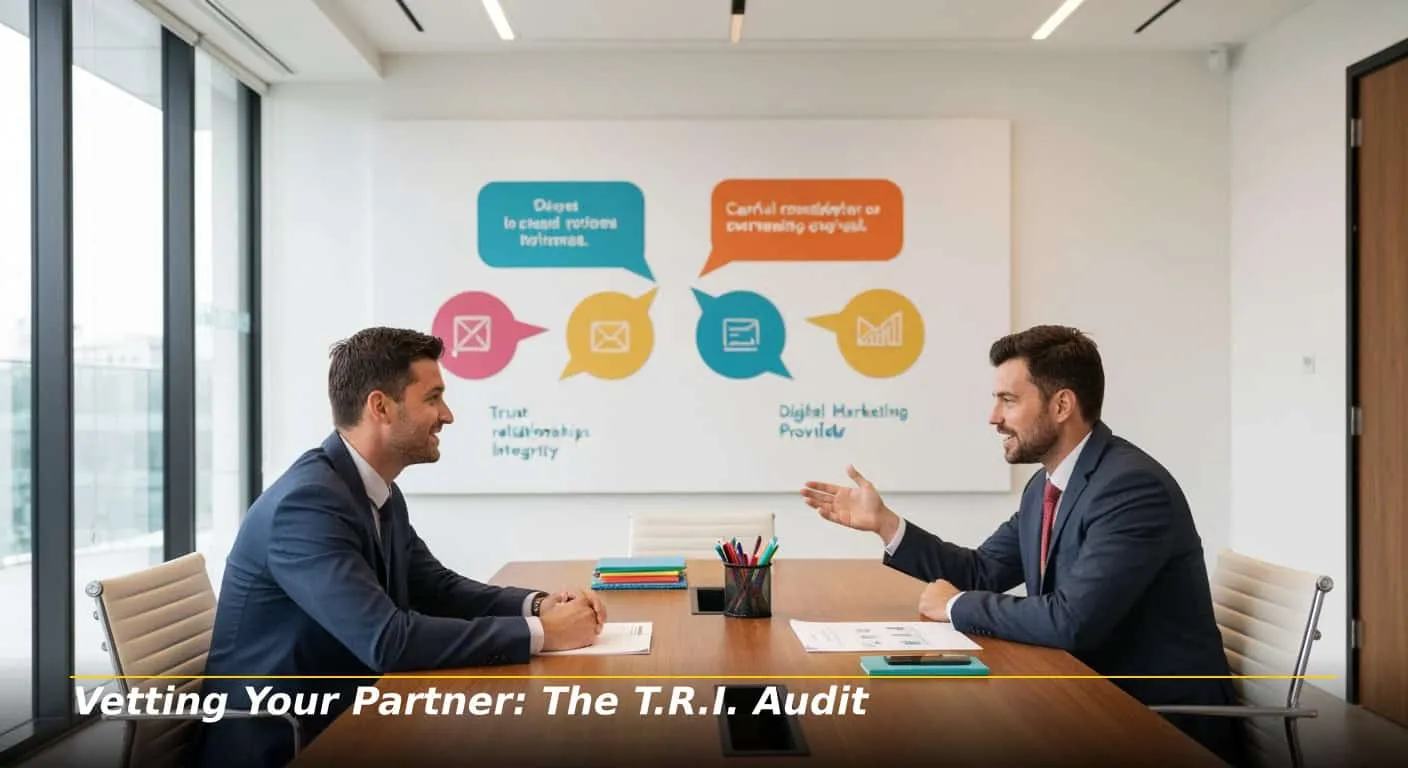
Selecting a digital marketing provider is a critical business strategy. Many unqualified providers masquerade as professionals, but you can filter them out by looking for the T.R.I. Core Values.
- Trust: They value transparency and treat the process as a partnership. They explain the How and “Why” of their strategy rather than hiding behind jargon.
- Relationships: Being results-driven and relationship-focused. They take the time to learn about your short- and long-term goals rather than just asking about your budget.
- Integrity: They tell you what you need to hear, not what you want to hear. Offers honest recommendations based on logic and data.
The Pit Crew Selection Checklist
Before signing a contract, ask these five critical questions:
- Rankings: “Does your own agency rank in the top 10 for competitive keywords like ‘Web Design’ or ‘SEO’ in your area?”
- Contracts: “Will you provide a written agreement with explicit performance guarantees (e.g., 60-80% of keywords ranked in 4-6 months)?”
- Ownership: “Will I legally own my domain name and all website content from day one?”
- CMS Coaching: “Do you specialize in CMS (ex. WordPress) and will you coach me on how to update my own content without paying extra fees?”
- Reports: “Will you provide monthly progress reports that show impressions, traffic sources, and conversion rates?”
Conclusion
Navigating the AI era requires more than having a website. It requires commitment to being a digital mouse;a fast-moving, content-driven leader that understands the Galilean reality of the modern web. By building a technical foundation based on speed and mobile-responsiveness, creating expert-led content through the E-E-A-T framework, and partnering with a T.R.I.-certified pit crew, transforming your digital presence into a dominant business asset. The internet has leveled the playing field; now is the time to leverage the power of content to win the race against the elephants and claim your share of the marketplace.
FAQs About Scaling Your Small Business in the Era of AI Search with Content Marketing:
1. What is the difference between Answer Engine Optimization (AEO) and traditional SEO?
Traditional SEO focuses on keywords and backlinks to rank in a list of links. AEO is a new discipline that focuses on making your content so clear, authoritative, and structured that AI agents (like ChatGPT) can easily extract and cite your information as the direct answer for a user.
2. Is content length important for ranking in the AI era?
While quality always beats quantity, research suggests that the average length of a first-page article ranked by Google is around 2,000 words. However, for AI-friendliness, you should break up long posts into separate, easily digestible articles or chapters to keep users engaged.
3. Why should I avoid renting a website from a hosting company for a low fee?
Cheap cookie-cutter templates ($5-$15/month) often mean you do not own the domain or the content. These sites blend your identity with thousands of others, making you look average. If you ever decide to leave that provider, they may hold your site hostage. Always prioritize custom-designed sites that you legally own.
4. How can I manage my online reputation effectively?
You must proactively earn complimentary reviews from satisfied customers. Online reviews are the most critical factor for gaining trust, with 92% of customers reading them before a purchase. Use tools like HootSuite or Buffer to track social mentions and respond to reviews promptly to demonstrate outstanding customer service.
5. How long does it take for a content marketing campaign to show results?
Content marketing is a long-term investment yielding compounding returns. While initial results typically appear within 4 to 6 months, the real value builds over years as your content becomes an established industry reference and continues to attract qualified leads.
6. Do I need a domain-based email address?
Yes. Using an email like [email protected] instead of a personal @gmail address shows potential customers that you are a legitimate source. It builds trust during the initial discovery phase when the customer doesn’t know you well yet.
7. How can AI help my business beyond search visibility?
AI tools can automate repetitive tasks like scheduling and sorting emails, safeguard your data, and help you make better decisions by analyzing customer data. This acts as a force-multiplier for small teams, allowing you to operate with the efficiency of a much larger organization.
